Stay connected ... follow us on our social networks


MÓIN CHOINN
Cill Chainnigh
Official GAA and Camogie Club Website


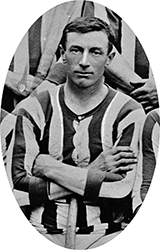
Richard (Dick) ‘Drug’ Walsh was born on 30th December 1877 into a farm labouring family in Rathkieran, in a house on the Ballinlough (Creamery) road going towards Carrigeen village. His parents were William and Anastasia ‘Statia’ (née Quinn). As was the custom at the time, he was baptised the next day. His parents had seven children altogether; four boys and three girls.
First things first, how did his nickname - ‘Drug’ or ‘Droog’ - come about. He is said to have picked it up in primary school when the class were singing the song ‘Clare’s Dragoons’ - also known as ‘the Bould Dragoons’ - which was a popular marching song at the time. The Clare Dragoons were an army regiment and the song dates back to the early 1800s. His friends nicknamed him ‘Droog’, because of his mispronunciation of the word ‘Dragoons’. Obviously they thought it was hilarious the way he was pronouncing it! Like all good nicknames, it stuck for life. As he got older, his ‘Droog’ nickname got corrupted into its usual spelling; ‘Drug’. He would become known far and wide as simply; ‘The Drug’. Indeed, if his four letter name was mentioned throughout Ireland in the early part of the 20th century, people would know who was being talked about. It is worth noting however, that on a few occasions, Drug said he had hated his nickname, but he could do nothing about it now!
Hurling Career
Drug, by all accounts, was a natural athlete from young age. Considering he was already six-years-old before the GAA was even founded in 1884, he very quickly got up to speed with the games of hurling and gaelic football. Hurling had been played sporadically in the Mooncoin area even prior to the GAA being founded, usually, as part of a one day entertainment festival in the summer. But even if the GAA hadn’t been established, it’s very likely Drug would have excelled in another arena - such as athletics which was very much in vogue at the time - considering all his natural abilities.
He started playing with the Mooncoin club in the late 1890s. It is not known exactly when Drug made his debut for Mooncoin as records were not as detailed in the early years of the GAA. The senior team at the time would have been difficult enough to break on to, and subs were usually only used if someone was badly injured. By the way, Mooncoin GAA during this era was often referred to by an old name for area; ‘Moondharrig’, which translates as ‘red bog’ in Irish. This was a slight variation on ‘Mooncoin’, which is translated as ‘Coyne’s Bog’ or perhaps ‘Quinn’s bog’ in Irish. Needless to say, the area around Mooncoin village must have been fairly marshy and boggy in its day.
It is possible Drug Walsh may also have been something of a late developer on the hurling front. But in many ways, this was caused by circumstances beyond his control. There were no minor or U20 championships in those days, or any juvenile GAA for that matter, except in some primary schools. Furthermore, during Drug’s formative teenage years, between 1890-1896, there was little GAA played in Kilkenny, which was something that was mirrored around the country as the fledging GAA organisation tried to find its feet. However, we do know that Drug broke onto the senior Mooncoin team in the early 1900s but did not make his debut for Kilkenny until he was 28 years old against Dublin in the Leinster Final of the 1904 championship (played in 1906). As he made his debut that day, little did he know what he would go on to achieve over the next 10 years; it would have been beyond his wildest dreams. Remember, Kilkenny hadn’t even won one All-Ireland at this stage when Drug joined the team. Indeed, Kilkenny had lost four All-Ireland finals the previous decade to Tipperary (x2), Cork and Limerick. People wondered would they ever win one.
They needn’t have worried. It was in Drug’s debut season with Kilkenny that they won their first All-Ireland senior hurling final. The match was played near Carrick-on-Suir at Maurice Davin’s sports field on 24th June 1906. But it was for the 1904 hurling championship. The delayed championships at the time certainly worked in Drug’s favour. He had only broken onto the Kilkenny team in the spring of 1906 and if the championships had been played out on time the previous two years, he would have missed out. The 1904 All-Ireland Final was a ‘Roy of the Rovers’ type final debut final for Drug. Relatively unknown before the match outside of Mooncoin, he wrote his name into the history books and instantly became famous. With time almost up and the side’s level, the ball broke to Drug in the middle of the field. He turned and shot a long range effort over the crossbar as Kilkenny claimed their maiden All-Ireland hurling title on a score line of; Kilkenny 1-9, Cork 1-8. Jack Rochford, Kilkenny’s fullback on the day, described that moment as follows:
“Jim Kelleher (Cork) pucked out a long ball that came to our twenty-one yard mark. There was Danny Harrington (Cork), a hardy boy, waiting for it and as he raced in towards our goal I ran out to meet him. ‘Fox’ Maher (Kilkenny goalkeeper) shouted to “come back”. I made a mock drive at Harrington, he raised the ball and hit me in the chest and as it fell behind me, Fox caught it, drove it up to Drug at centre field, and in a tick, the point that gave Kilkenny its first All-Ireland was scored.”
It really was a dream debut season for Drug Walsh. Kilkenny also won the following year’s Championship, beating Cork again, this time after a replay. Generally, what seems to have set Drug apart was his athleticism and fitness levels, along with his unquestionable skill with a hurley. Drug was well above average height for the era - around 5ft 10”. Along with his supreme fitness, he had an exceptional burst of speed and had a brilliant delivery. Although group training was, by today’s standards, primitive, Drug none the less had his own training regime at home. The likes of skipping and lifting weights were examples of how he maintained his fitness and got himself ready for matches. In many ways, he was a man ahead of his time.
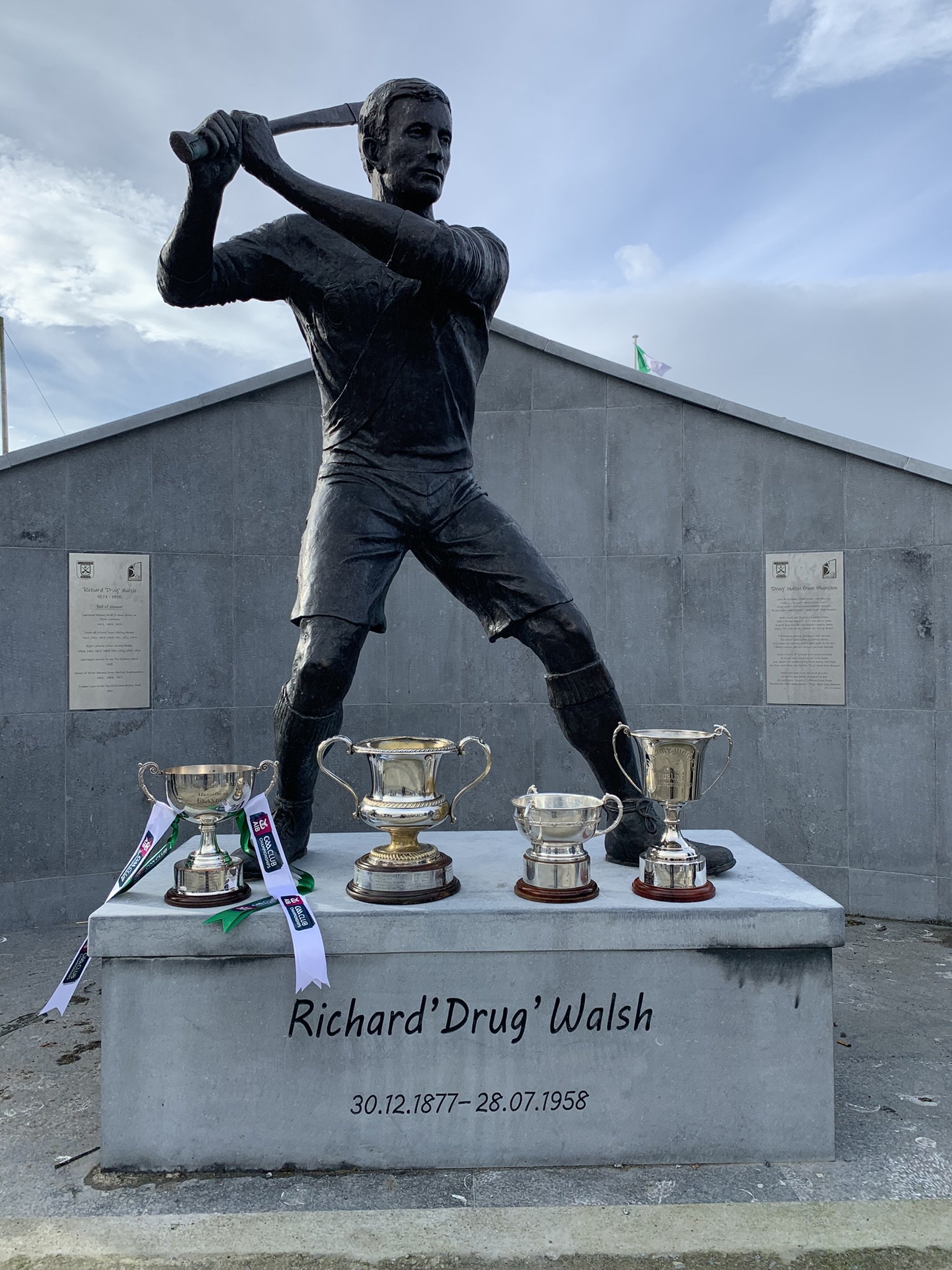
His ingenuity and attention to detail in trying to make himself a better player even stretched to the hurleys he used. He made his own grip for his hurley (as can be seen in the statue), something most of his contemporaries hadn’t even thought of. He was always looking for that extra edge.
Drug was also said to have been a great leader amongst his teams. In 1907 he was made captain of the Mooncoin senior hurlers, a title he held for the next five years. He drove his teams to victory on many occasions. Drug usually played full-back for Mooncoin and centre-back for Kilkenny. With Drug as captain in 1908, Mooncoin won the senior county championship, beating Threecastles on a score line of Mooncoin; 5-17, Threecastles; 3-5. Drug was arguably the best player on the field that day.
Achievements
Around the same time, Drug was made captain of the Kilkenny senior hurling team. He captained them to victory in the 1907 All-Ireland hurling final – played in 1908. He would go on to captain Kilkenny to two further All-Ireland finals in 1909 and 1913. This record has not yet been broken; Drug is still the only man to captain Kilkenny to three Senior Hurling Championship victories. Outside of Kilkenny, the next man to equal Drug’s feat of captaining three All-Ireland winning hurling teams was Christy Ring of Cork (and of course something Limerick achieved more recently). Indeed, Drug, along with three of his Kilkenny golden era teammates, haul of seven All-Ireland medals was not equalled until Ring came along in the 1950s. The 1909 All-Ireland was the first time Kilkenny beat Tipp in the final, and it was also the first time Tipperary had lost an All-Ireland final, which made victory for Kilkenny and captain Drug all the sweeter.
In winning his seven All-Ireland medals, Drug was part of a Kilkenny team that beat Cork four times and Tipperary three times. The All-Ireland championships he won were; 1904, 1905, 1907, 1909, 1911, 1912 and 1913. He also captained Leinster to the Railway Shield title in 1908. Although the team was mostly made up of Kilkenny players, he was on this one occasion able to play side-by-side with fellow Mooncoin native and Laois player Bob O’Keeffe (who the Leinster Hurling Championship cup is now named after). The year 1913 could be considered Drug’s crowning glory. At the age of 36, he secured his last All-Ireland medal as captain in the soon-to-be famous Croke Park (Jones Road), and it was against the old enemy Tipperary who were the red hot favourites. It was also Kilkenny’s first three-in-a-row. To add the icing to the cake, Drug captained Mooncoin to his last senior club medal against arch-rivals Tullaroan.
Drug was captain of Kilkenny again in 1914, when Kilkenny were surprisingly beaten by Laois in the Leinster Final by a last minute goal. That game was his final curtain call. He was, however, brought back onto the extended Kilkenny panel that won the Leinster Final in 1916 when he was nearly 39 years old.
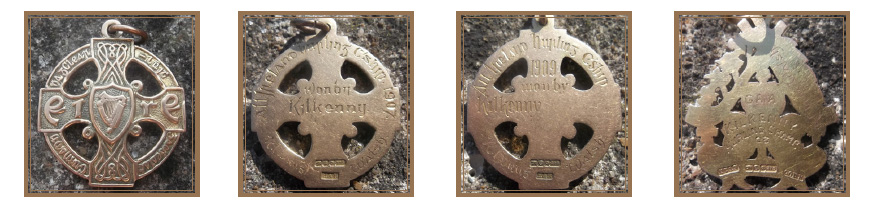 Drug’s 1907 and 1909 All-Ireland and 1908 County Championship Medals
(R. Drug Walsh can be seen engraved on the back)
Drug’s 1907 and 1909 All-Ireland and 1908 County Championship Medals
(R. Drug Walsh can be seen engraved on the back)Laois 1915
Drug was certainly not one to hold a grudge! After Kilkenny had been beaten by Laois twice, in 1914 and 1915, Drug imparted his expertise when Laois reached the All-Ireland Hurling Final of 1915. The connection was that Bob O’ Keeffe of Glengrant, Mooncoin, was a teacher in County Laois and captain of the Laois hurlers in 1914. He would later become president of the GAA. Drug was asked to travel to Laois in the weeks before the final to help train the Laois men which he was delighted to do. They had lost the All-Ireland the previous year and were determined 1915 would be their year. Drug travelled by train from Kilmacow, which at the time had a direct connection to Portlaoise via Kilkenny. Drug must have been in his element. The Laois team were training with near military precision with elaborate drills, unheard of in most counties. Copies of the practice drills still survive and included catching, dribbling (soloing), striking, sideline pucks, frees and ‘fighting for possession’. Supporters in that county fundraised so the team could take time off work to train and wouldn’t be out of pocket. Drug even invited some of his former Kilkenny comrades to training to inspire the Laois men who were going for their first All-Ireland. It worked. Cork were shocked to lose the 1915 All-Ireland hurling final by seven points, in a brilliant performance by Laois; to date, their only hurling All-Ireland victory.
Drug played with Mooncoin for a few more years but the turmoil in the country caused by the First World War and the aftermath of the 1916 Rising, did, perhaps, push him gently into retirement. The 1916 county championships, which looked to be proceeding at pace in the spring of 1916, were not eventually completed until June 1919, due to the government prohibiting GAA matches after the Easter Rising and the subsequent turmoil that followed, until after the war had ended. By this time Drug was 42 and no longer playing. He would have been happy with the county final result however, as Mooncoin were victorious over great rivals Tullaroan. The last known match Drug played in was in 1924 when he was 46 years old. In that game - played in St James Park, Kilkenny (where the greyhound stadium is now), he captained the famous Kilkenny golden era team who came out of retirement to play the younger Kilkenny team in a friendly challenge. The younger team won unsurprisingly!
Personal Life
Due to the economic conditions of the era in the 1920s, Drug spent some time in England and the United States. He then returned home and moved to the Main Street in Mooncoin where he lived most of his life. He made his living as a general labourer, mostly working on farms around the area. He never married. Indeed, he had struggled with the idea that he might have to emigrate as early as 1911, just before Kilkenny won their famous three-in-row. However, a massive hurling tournament was organised in his honour in Waterford, with players coming from all over the county and beyond to participate. Special trains arrived from Clonmel, Kilkenny and Wexford. The Mayor of Kilkenny was paraded onto the pitch before the matches behind the St. John’s Brass Band who had travelled down from Kilkenny especially for the occasion. As one writer put it at the time: ‘there is no need of a commendation of Drug’s character to the public. He is already generally known as one of the very best of souls. He is a good honest Irishman … as [has] ever breathed’. During the 1920s, there were other ‘Drug Walsh Tournament’s’ held in Waterford City. Many clubs such as Tullaroan, James Stephens and Dicksboro travelled down to play in these games, including a young Lory Meagher. In 1926, 5,000 people attended the final of the Tournament in Waterford.
Drug, at one point, did go to US to play in a New York championship final. He was invited by Mooncoin native Dick Quinn, who founded the ‘Kilkenny’ club in New York in 1905, but because the ship was delayed by bad weather the final was already over by the time Drug got there. He was sent back home on the same ship!
It could all have been so very different. Drug was lucky to escape with his life following a cot fishing accident in June 1907. Fishing was a passion of his and he was skilled at snap-net cot fishing, which was unique to this part of Ireland. The River Suir was famed for its salmon and the record for the largest salmon ever caught in Ireland was recorded on the Suir some years earlier (a fish weighing 57lbs). Salmon fishing was also a good way for the locals to earn a little extra money. On the night in question, 5th June 1907, Drug went cot fishing with three others. However, when his fishing partner stood up to pull in the nets, the boat overturned. Although Drug did his best to help him, his friend became tangled in the nets and was drowned. Drug himself went under and was pulled from the water unconscious. It must have been a traumatic time for all involved.
Drug’s parents though, William and Statia, who had moved to Polerone in later life, did live to witness their son’s success and near hero status. His father passed away in 1913 and his mother in 1921.
Death
Richard ‘Drug’ Walsh died in hospital in Kilkenny on 28th July 1958, after previously suffering a stroke. He was 80 years old. In a way, perhaps it was apt he died in Kilkenny City, the place he won many a famous victory and where he attended numerous homecomings and banquets as a Kilkenny player. Drug’s coffin was paraded through the streets of Kilkenny, with a guard of honour provided by generations of hurlers, with his coffin draped in the Mooncoin and Kilkenny colours. He was then brought back ‘home’ to Carrigeen church where he was buried in the adjoining cemetery along side his parents.
Poem by Reverend Monsignor Michael O’Hanlon (1920-1967)
"Drug Walsh" - of Mooncoin
Come all you young fellows to my my story give ear,
I tell of a stalwart, 'mong hurlers a peer
Whose name is still cherished wherever they join
By sportsman and trueman - "Drug" Walsh from Mooncoin.
When Cusack and Davin set a nation aflame
With a fervour and pride in its own native game
A youth from the Suirside plucked a shapely caman
Saying "Ill strike for my sireland, fair Erin go Brath".
Full many an evening 'mid shouts loud and gay.
The sliotar sped swiftly in sportive affray.
O'er green sod and cross road, a dark youth to the fore
Whose prowess and skill -hurling's garlands foretold.
Seven times in All-Irelands with victory crowned
A record whose equal has yet to be found-
Four gallant ate numbered, Rochford, Walton,Dick Doyle,
And that youth from the Suirside, "Drug" Walsh from Mooncoin.
With eagle-eyed vision and speed of a deer,
No matter how hectic, in combat- no fear
His wristwork - an artist's, Kilkenny's own Doyen
Reigned the Prince among hurlers, "Drug" Walsh from Mooncoin.
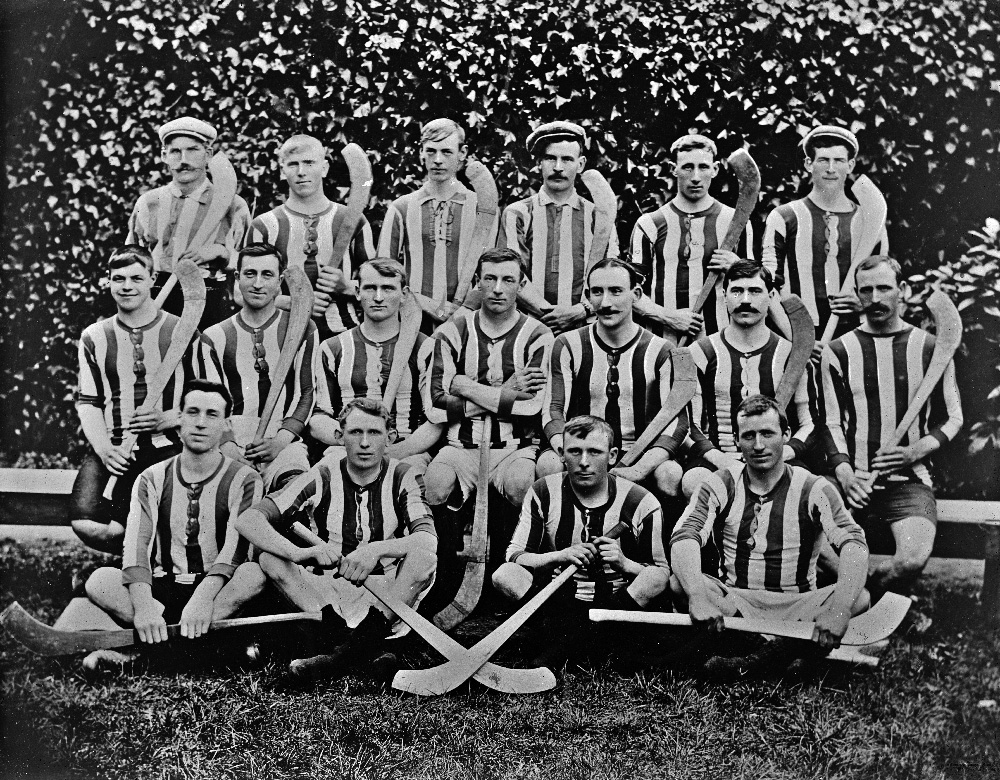
The 1909 All-Ireland Kilkenny Winning Team
The photo belowis perhaps one of the most famous to include Drug Walsh. He is joined in this photograph by nine other players who hailed from Mooncoin. Kilkenny beat Tipperary in that final on a score line of Kilkenny: 4-06, Tipperary: 0-12.
Back row (L-R): Sim Walton (Tullaroan), Bill Hennebry (Portnascully, Mooncoin), Jim Dunphy (goalkeeper, Mooncoin), Jack Rochford (Threecastles), Paddy ‘Icy’ Lannigan (Erins Own), Jack Keoghan (Tullaroan)
Middle row (L-R): Jim Ryan (Ballygorey, Mooncoin), Eddie Doyle (Dournane, Mooncoin), Joe Delahunty (Curraghmartin, Mooncoin), Richard ‘Drug’ Walsh (Capt.) (Rathkieran, Mooncoin), Matt Gargan (Erins Own), Dan Kennedy (Tullaroan), Mick Shortall (Erins Own)
Front row (L-R): Mick Doyle (Dournane, Mooncoin), Dick Doherty (village, Mooncoin), Jimmy Kelly (Ballygorey, Mooncoin), Dick Doyle (Dournane, Mooncoin)
Hurley
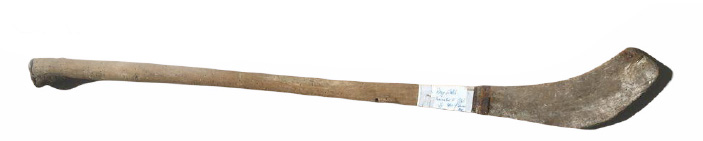
The actual 38” hurley (or caman as it was known then) that Drug played with was presented to the club by Mrs. Doran, Carrick Road in 2011. Pictured above, it was used in this project by sculptor Séamus Connolly to make the mould of the hurley that Drug is holding. It will be restored and permanently displayed in our club complex for all to view this unique piece of our club heritage.
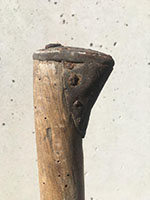
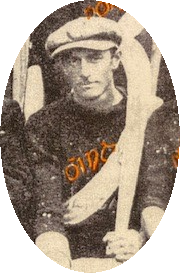
As can be seen in this photo, Drug was very much ahead of his time. He created a piece to add to the butt of his hurley to help with grip which no doubt was the precursor to the hurley design used today. This unique piece is visible on the statue on the butt of the hurley in Drug’s hands.
Jersey
In planning the sculpture, the question arose as to which jersey should be depicted to best reflect Drug’s illustrious career spanning both club and county. In Drug’s era, the Kilkenny or the Mooncoin jersey colours that we now take for granted, Kilkenny’s unique vertical black and amber stripes and Mooncoin’s famous green jersey with white sash had not been settled on. Both Mooncoin and Kilkenny appeared in various different jerseys in the first decade or two of the last century. It was decided that the Mooncoin jersey as also worn by Kilkenny in 1907 when Drug first captained Kilkenny to victory, best reflected Drug’s career, both with his native Mooncoin and Kilkenny.
The jersey with the sash also had the words “Móindharrig” depicted. The name was adopted by the Mooncoin hurlers in the early days and the club was commonly referred to as Móindharrig well into the last century. The deeds of the Mooncoin hurlers were made famous in song and story by the Mooncoin poet priest Fr. JB Dollard from Ballytarsney in his poetry and his writings, when he published a collection of short stories called ‘The Gaels of Moondharrig’ in that same year 1907.